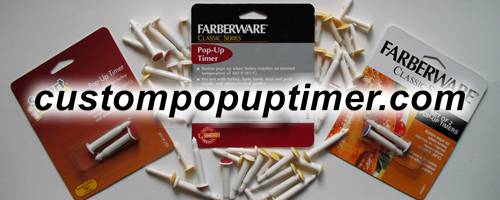
Custom Pop Up Timers vs Standard Products: When Food Companies Need OEM Solutions
Custom Pop Up Timers vs Standard Products: When Food Companies Need OEM Solutions
When purchasing disposable pop up timers, food companies often need to decide between standard products and customized OEM solutions.
Standard products can be suitable for general applications, but many food manufacturers, private label brands, and large-scale processors have unique requirements related to temperature specifications, packaging, branding, or supply chain management.
Understanding the differences between standard and custom pop up timers helps companies make better sourcing decisions.
What Are Standard Pop Up Timers?
Standard pop up timers are pre-developed products designed for common applications.
They usually provide:
- Established specifications
- Ready-to-order availability
- Simplified purchasing process
- Lower development requirements
For companies with general product requirements, standard solutions can be an efficient choice.
What Are Custom Pop Up Timers?
Custom pop up timers are developed or modified according to specific customer requirements.
Customization may involve:
- Activation temperature
- Packaging format
- Private label requirements
- Product application
- Supply program design
OEM solutions are designed to better match a company's specific product strategy.
When Standard Products May Be the Right Choice
General Food Applications
Companies using common product specifications may not require extensive customization.
Small Initial Projects
For companies testing a new market, standard products may provide a simpler starting point.
Short-Term Purchasing Needs
When requirements are straightforward, standard products can reduce project complexity.
When Food Companies Should Consider OEM Customization
Unique Product Requirements
Some food products require temperature specifications or application solutions that standard products may not provide.
OEM development allows manufacturers to create products based on actual application needs.
Private Label Brand Development
Retail brands often require customized packaging and product presentation.
OEM cooperation allows companies to develop products that match their own brand identity.
Large Volume Purchasing
For companies purchasing in larger quantities, customization can provide better long-term supply planning.
Market Differentiation
In competitive food markets, customized product features can help brands create additional value.
Key Differences Between Standard and Custom Pop Up Timers
| Category | Standard Product | Custom OEM Solution |
|---|---|---|
| Specification | Fixed specifications | Adjustable according to requirements |
| Packaging | Existing packaging | Custom packaging options |
| Branding | Limited | Private label support |
| Development | Minimal | Collaborative development |
| Application | General use | Specific product requirements |
Cost Considerations When Choosing OEM Solutions
Many companies assume customization always means higher cost. However, the decision should consider the overall business value.
OEM solutions may provide benefits such as:
- Better product matching
- Improved brand positioning
- More efficient supply planning
- Reduced long-term sourcing complexity
The right choice depends on business goals, not only the initial purchase price.
How to Decide If Your Company Needs Custom Pop Up Timers
Evaluate Your Product Requirements
Consider whether your food product has special requirements related to cooking, packaging, or customer experience.
Consider Your Market Position
Premium brands and private label products often benefit more from customization.
Review Your Long-Term Plans
Companies expecting continuous sales growth may prefer solutions designed for long-term cooperation.
The OEM Development Process Compared With Standard Purchasing
Standard Purchasing
The process is usually:
- Select existing product
- Confirm quantity
- Arrange delivery
OEM Development
The process usually includes:
- Requirement discussion
- Specification confirmation
- Sample evaluation
- Production planning
- Long-term supply cooperation
Common Mistakes When Choosing Between Standard and Custom Products
Choosing Customization Without Clear Requirements
Customization should solve a real business need rather than simply add complexity.
Selecting Standard Products for Unique Applications
Products with special requirements may need a more suitable OEM approach.
Ignoring Future Growth
The best sourcing decision should consider both current demand and future expansion.
Frequently Asked Questions About Custom Pop Up Timers
Are custom pop up timers more expensive than standard products?
Customization may require additional development, but it can provide greater value for specific applications and long-term projects.
Do all food companies need OEM solutions?
No. Standard products can be suitable for many applications, while OEM solutions are valuable when specific requirements exist.
What can be customized?
Customization may include temperature specifications, packaging, branding, and product application solutions.
Why do large food companies prefer OEM suppliers?
OEM suppliers can provide more flexible solutions, better communication, and long-term production support.
Choosing the Right Solution for Your Food Business
The choice between standard and custom pop up timers depends on product requirements, market strategy, and supply chain goals.
For companies seeking simple purchasing, standard solutions may be appropriate. For brands requiring differentiation, flexibility, and long-term cooperation, OEM customization provides greater opportunities.
A professional manufacturer can help companies identify the right approach and develop solutions that support their business objectives.
Disclaimer: The term "pop up timer" is a commonly used product category name referring to disposable cooking temperature indicators. We are an independent manufacturer based in China specializing in disposable pop up timers and temperature indicators since 2006. We have no affiliation, authorization, partnership, or relationship with any other brands or companies. Our products are independently manufactured and supplied to global B2B customers.