OEM Custom Pop Up Timers: What Food Brands Need to Know Before Starting a Private Label Project
OEM Custom Pop Up Timers: What Food Brands Need to Know Before Starting a Private Label Project
For food brands, poultry processors, and retail suppliers, developing a private label product requires careful planning across every component of the supply chain. While a disposable pop up timer may be a small part of a finished food product, it plays an important role in consumer confidence, cooking consistency, and product differentiation.
Many companies looking for OEM custom pop up timers are not simply searching for a lower-cost component. They are looking for a reliable manufacturing partner that can support product customization, stable production, quality control, and long-term supply.
This article explains how OEM pop up timer projects work, what customization options are available, and what professional buyers should consider before selecting a manufacturing partner.
Why More Food Companies Are Choosing OEM Pop Up Timers
The food industry has become increasingly competitive. Supermarkets, food brands, and processors are constantly looking for ways to improve product presentation and create stronger market recognition.
A standard disposable pop up timer can provide basic temperature indication, but an OEM solution allows companies to develop a product that matches their specific market requirements.
Common reasons companies choose OEM pop up timers include:
- Creating private label food products
- Improving brand recognition
- Supporting different cooking applications
- Developing customized retail packaging
- Building a stable direct supply relationship
What Does OEM Mean in Disposable Pop Up Timer Manufacturing?
OEM (Original Equipment Manufacturer) means that a specialized factory produces products according to a customer's requirements.
For disposable pop up timers, OEM cooperation may include product design adjustments, temperature customization, appearance changes, packaging development, and production planning.
Unlike buying standard products from a distributor, OEM cooperation allows buyers to have greater control over the final product specification.
Main Customization Options for OEM Pop Up Timers
Professional buyers usually evaluate customization capability before placing large-volume orders. The most common OEM options include the following:
1. Custom Activation Temperature
Different food products require different target cooking temperatures. A turkey manufacturer, chicken processor, and ready-meal producer may have different requirements.
Custom temperature options allow companies to match the pop up timer performance with their own production process.
Typical applications include:
- Whole turkey products
- Roasted poultry products
- Frozen-to-oven food products
- Prepared meal solutions
- Commercial roasting applications
2. Custom Color Development
Color customization is often used by food brands to create product recognition or differentiate between different temperature models.
For retail products, a customized indicator head color can help consumers quickly identify the product while supporting brand consistency.
3. Logo Injection and Brand Identification
For private label projects, logo customization is an effective way to create a branded component inside the final food package.
Logo injection on the timer head allows manufacturers and brands to strengthen product identity without changing the basic function of the timer.
4. Custom Packaging Solutions
Packaging requirements vary significantly between different markets and sales channels.
OEM packaging options may include:
- Bulk packaging for food processors
- Polybag packaging for industrial users
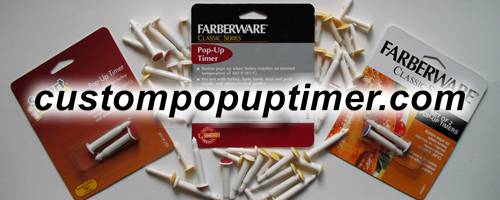
- Retail blister card packaging
- Display box packaging
- Private label packaging design
The OEM Production Process for Disposable Pop Up Timers
Understanding the manufacturing process helps buyers select suppliers more effectively.
Step 1: Requirement Confirmation
The manufacturer first confirms customer requirements, including:
- Application purpose
- Target temperature
- Quantity requirements
- Packaging format
- Customization needs
Step 2: Product Specification Review
Before mass production, technical specifications are reviewed to ensure the product matches the customer's intended application.
Important factors include material selection, temperature response, mechanical structure, and packaging requirements.
Step 3: Sample Testing
Professional buyers usually evaluate samples before moving into bulk production.
Testing may include:
- Activation temperature verification
- Appearance inspection
- Packaging evaluation
- Application testing
Step 4: Mass Production and Quality Control
After approval, the manufacturer begins bulk production with quality monitoring throughout the manufacturing process.
For international B2B buyers, stable batch consistency is one of the most important supplier evaluation factors.
Why Direct OEM Factory Cooperation Benefits Global Buyers
Many companies initially purchase disposable pop up timers through trading companies or distributors. However, as order volume increases, direct cooperation with a factory often becomes more valuable.
Factory direct OEM cooperation provides several advantages:
- Better communication between buyer and production team
- More flexible customization options
- Improved cost control
- Better understanding of product requirements
- Long-term supply planning
Industries That Commonly Use OEM Pop Up Timers
OEM disposable pop up timers are used across multiple food-related industries.
Poultry Processing Companies
Large poultry processors use disposable temperature indicators for roasted chicken, turkey products, and other cooked poultry applications.
Frozen Food Manufacturers
Frozen food companies may integrate pop up timers into oven-ready products to improve consumer cooking guidance.
Supermarket Private Label Brands
Retail chains often require customized components and packaging to support their own branded food products.
Food Service Suppliers
Commercial food suppliers use disposable cooking indicators to support standardized preparation processes.
Frequently Asked Questions About OEM Pop Up Timers
What is the minimum order quantity for OEM pop up timers?
MOQ requirements depend on customization level, packaging requirements, and production specifications. Bulk production projects usually provide more flexibility than small retail orders.
Can the temperature setting be customized?
Yes. OEM manufacturers can develop different activation temperature options according to the customer's food application requirements.
Can a company add its own logo to disposable pop up timers?
Yes. Logo injection and appearance customization are common options for private label and OEM projects.
Are OEM pop up timers suitable for international food companies?
Yes. Disposable pop up timers are widely used by food processors, poultry companies, and retail brands worldwide. Export experience and quality control capability are important factors when selecting a supplier.
Building a Long-Term OEM Partnership
A successful OEM project depends on more than product customization. The ideal manufacturing partner should understand food industry requirements, maintain consistent quality, and provide reliable production support.
For companies entering new markets or expanding existing food product lines, a specialized disposable pop up timer manufacturer can provide the technical experience and supply capability needed for long-term growth.
Choosing an experienced OEM partner allows food brands to focus on their products while ensuring that every cooking indicator meets their market expectations.
Disclaimer: The term "pop up timer" is a commonly used product category name describing a disposable cooking temperature indicator. We are an independent manufacturer based in China specializing in disposable pop up timer production since 2006. We are not affiliated with, authorized by, or connected to any other brands or companies in the industry. Our OEM and custom products are independently manufactured for global B2B customers.